
Motivating and easy-to-follow app. I like it 🙂
★★★★★
Working from home removed one of our most reliable movement habits. This is how to bring it back without having to return to the office.
Remote and hybrid work have transformed the way millions of Americans work. Today, 23% of US workers now follow a hybrid schedule, while 17% work fully remotely[1]. For many, the daily trip to the office has disappeared, bringing more flexibility, extra time, and less commuting stress. But the commute wasn't just a way to get to work, it was also a built-in source of daily movement. Even for many Americans who commute by car, getting to and from work often involves more physical activity than working from home.
Those trips from the parking lot and moments spent moving around the office may have seemed small, but they added up. These everyday bursts of activity helped people stay active, support their physical health, and burn calories. Our latest analysis reveals just how much incidental movement many people have lost as commuting habits have changed, from the steps and miles once covered each day, to the time spent moving and the calories burned along the way.
We call this The Movement Commute: the movement that naturally occurs as part of travelling to and from work. As the way we work continues to evolve, understanding what we've lost is the first step toward finding new ways to bring that activity back into our everyday routines.
The daily commute is often viewed as time lost, but it also provides an opportunity for regular, incidental movement. Whether it's walking to a transit stop, taking the stairs, or walking to pick up lunch, these small bursts of activity can add up over time. To understand how much movement is being lost as more people work from home, we analyzed commuting-related activity across office workers, hybrid workers, and remote workers.
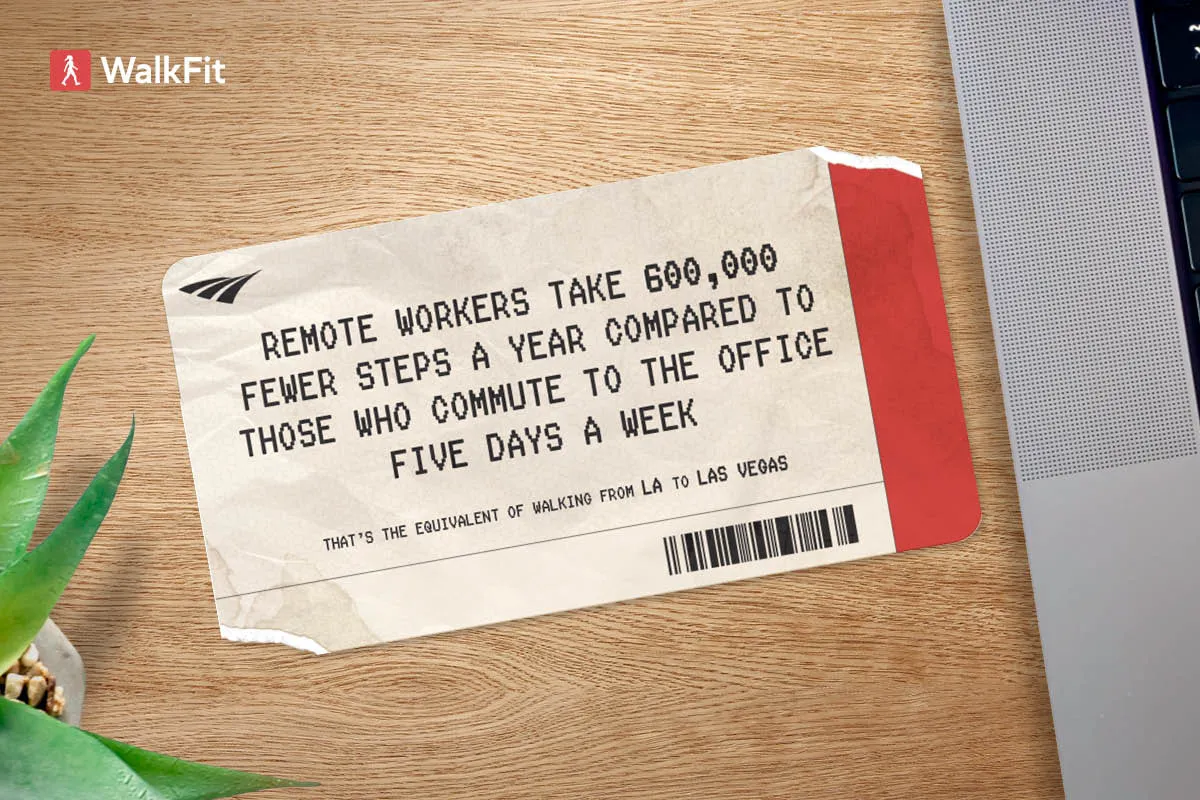
Our analysis revealed:
The daily commute does more than simply get us to work; it provides routine, structure, and a clear transition between home and work. As more people have shifted to remote and hybrid working, many of these hidden benefits have quietly disappeared. As walking coach, Ludgina Dieujuste, explains:
"People often underestimate incidental movement because it doesn't feel like exercise. Walking to the train, climbing stairs, going to lunch, and moving around the office may seem insignificant individually, but these activities add up.
"When commuting is removed, people are often surprised by how many daily steps disappear. What felt like 'just getting through the day' was actually contributing significantly to their overall activity level."
This type of activity is often referred to as non-exercise activity thermogenesis (NEAT), the energy we expend through everyday movement outside of structured exercise. Research has found that NEAT can vary by as much as 2,000 kcal per day between individuals, highlighting how routine daily activities can make a substantial contribution to overall energy expenditure[2].
While a morning run or evening gym session remains valuable, it doesn't fully offset the effects of spending most of the day sitting. Regular movement throughout the day plays a distinct role in supporting long-term health.
As Dieujuste explains: "Going to the gym is fantastic, but for most people, it represents only 30 to 90 minutes of their day. Even someone who exercises regularly can still spend the majority of their waking hours sitting.
"Daily movement improves circulation, blood sugar regulation, joint mobility, posture, energy levels, and mental well-being. It also helps reduce the negative effects of sitting for long periods. Think of exercise as a workout for your body, while daily movement is what keeps your body functioning optimally throughout the entire day."
The movement lost through commuting isn't just measured in steps. Over the course of a year, men who work in the office full-time burn an average of 30,000 more calories than those who work remotely, while women burn around 23,520.
While slightly less for hybrid workers, there is still a considerable difference. Men who work from home three days per week burn 18,000 fewer calories than those who work five days a week, while women on the same schedule burn 14,112 fewer calories.
These calorie gaps are driven solely by commuting-related movement, highlighting just how much activity can be built into our routines simply from travelling to and from work.
But the impact isn't just physical. The additional movement associated with commuting often translates into enough daily activity to support wellbeing. Research shows that just 20 minutes of physical activity each day can help reduce the risk of depression[3], suggesting the movement built into a daily commute was doing far more than simply getting us to work. It provided a simple, consistent habit that supported mental wellbeing too.
The idea of The Movement Commute is simple: to recreate the physical and mental benefits of a traditional commute, without needing to return to the office. It's about intentionally reintroducing short bursts of walking across the day to restore structure, transition time, and incidental movement that working life once naturally provided.
As walking coach Ludgina Dieujuste explains: "The goal shouldn't simply be to exercise once and sit the rest of the day. The goal should be to move consistently throughout the day."
Rather than being time-consuming, this approach is designed to be realistic and flexible, made up of small walks that support both body and mind.
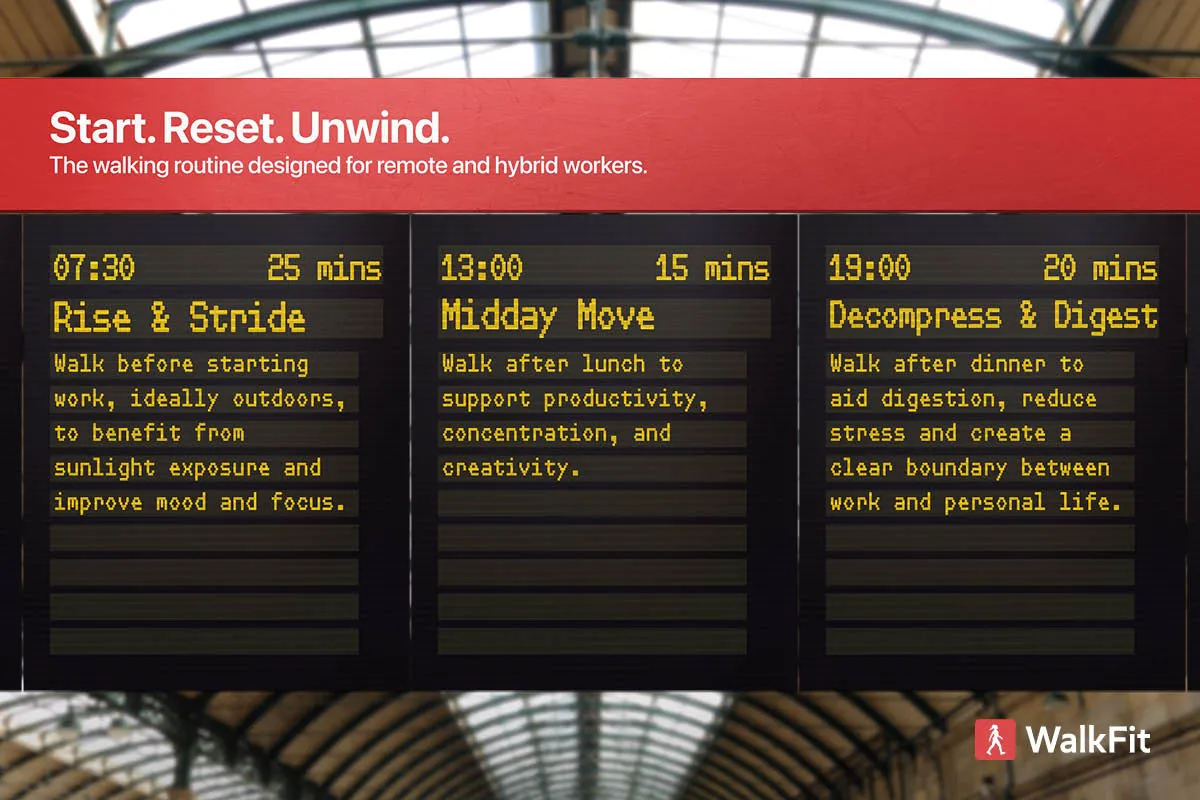
How to build your movement commute
Rise & Stride (25 minutes before work)
Helps boost alertness, improve mood, and tell your body and mind the working day is starting. Morning sunlight exposure may also support circadian rhythm and energy regulation.
Midday Move (15 minutes after lunch)
Breaks up prolonged sitting, supports digestion, and helps reduce the afternoon slump while improving focus, creativity, and productivity for the afternoon.
Decompress & Digest (20 minutes after work or dinner)
Creates a clear separation between work and personal time, supports digestion and helps to reduce stress and support better sleep.
Together, these three short walks can recreate much of what was once built into the daily commute. Not just the steps, but the structure, transition, and mental reset that came with it.
The most effective way to adopt The Movement Commute is to treat it as a structured part of the working day, which doesn't rely on motivation, but on routine.
To support this, we've created a reminder tool that allows people to add movement breaks directly into their calendar, creating scheduled reminders for their morning, midday, and evening walks.
By treating these as fixed points in the day, movement hopefully becomes easier to maintain and naturally embedded into the work routine.
Designed for Americans working from home on a remote or hybrid schedule, The Movement Commute helps restore the healthy walking habits many people lost when they stopped commuting. Choose your device below and we'll add all three walks directly into your calendar.
Downloads one calendar file (.ics) with all three walks, repeating daily for 10 weeks. Open the downloaded file to import into your calendar — on iPhone, tap it to add to Calendar; on Android, open with Google Calendar.
Sources:
[1] Federal Reserve
[2] PubMed
[3] BMJ
Methodology:
This analysis aims to quantify the differences in commuting-related physical activity among US employees who
work remotely, in hybrid arrangements, and in office-based roles. Data on the mean differences in daily step
counts between office-based employees and those working from home (WFH) were obtained from a meta-analysis that compared findings from multiple studies conducted across different countries.
The percentage of US employees working in hybrid and remote settings was sourced from nationally representative US workplace data. Official US statistics were also used to obtain average height and weight data for men and women. These figures were combined with step-count data to estimate the average movement and calories burned at three levels: daily, weekly, and annual. Estimates include the additional distance walked, steps taken, and calories burned through commuting-related movement that may be reduced when employees work remotely or from home.
About Ludgina Dieujuste: Ludgina Dieujuste is a walking and running coach, certified with the RRCA. She has a YouTube channel that has a library of walking content for all levels. She's passionate about helping her community to become stronger and better with each passing day. Ludgina loves to help others realize that fitness is a life-long journey and can be started at any age. Through cardio, strength, and proper nutrition you can change your life one day at a time.
People worldwide choose WalkFit to get the most out of walking for their health and fitness. See what they have to say about their journey with WalkFit.